

Weight Loss for Truck Drivers isn’t just about appearance. It’s a matter of survival in a profession where your body is your primary tool. I understand your situation because I’ve spent a lot of time on the road myself, watching the pounds pile on faster than the odometer racks up miles.
You work between 8 to 11 hours each day driving. You work in the confines of the driver’s seat, and your timetable is set by delivery schedules, not by the internal clock of your body. In such conditions, it’s funny to hear standard recommendations such as “just work out.”But I’m here to tell you: weight loss for truck drivers is possible, and it doesn’t require you to give up your job.
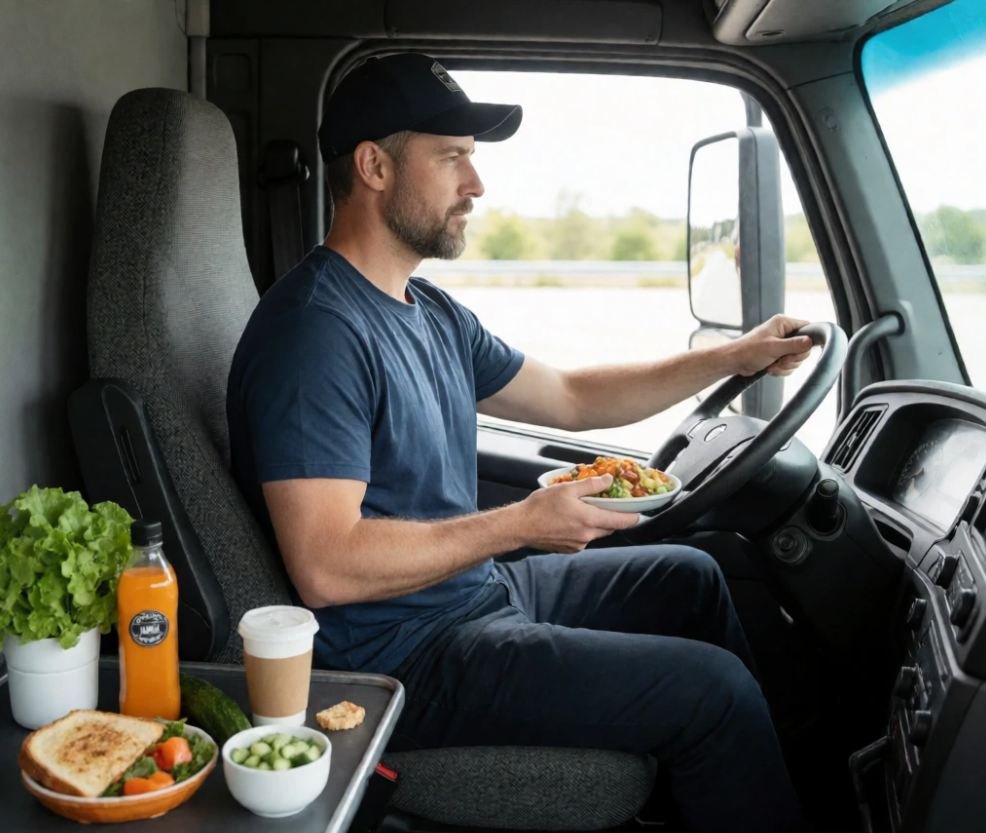
In this article, I’ll break down a proven strategy. We’ll speak in plain language, without any magic or complicated diets. I’ll give you specific tools that work right in the truck cab, at parking lots, and in roadside cafés. Let’s get started on this journey.
Table of Contents
Why excess weight is a truck driver’s worst enemy
Before we get into the tactics, let’s talk about your environment. Your body isn’t built for sitting still. When we sit for hours on end, our muscles—especially the glutes and the back of the thighs—”fall asleep.” It is called hypodynamia. Your metabolism slows down because your body thinks you’re in hibernation.
Add stress to the mix. Deadlines, harsh weather, lack of sleep—your cortisol (the stress hormone) levels go through the roof. High cortisol is a direct signal to your body: “Store fat, especially around your waist—it’ll come in handy.” On top of that, access to healthy food is limited. Fast food often dominates at rest stops, and finding a decent salad is harder than finding a gas station with a clean restroom.
But there’s good news. You don’t need to be an athlete. You need to become a smart manager of your own body. Weight loss for truck drivers is built on three pillars: nutrition, exercise in limited space, and sleep patterns. If you fine-tune these three mechanisms, the weight will start to come off, even if you don’t leave the cab.
Section 1: On-the-Road Nutrition Strategy (How to Beat the Roadside Food System)
Imagine that your body is a truck. If you fill the tank with bad fuel (chips, sugary soda, white bread), the engine (your body) will run rough, stall quickly, and start to “rust” (store fat). Your job is to refuel with high-quality fuel, even if there are only fast-food joints around.
The “Three Containers” Rule
The most practical advice I can give you is to buy a small car cooler or insulated bag. This is your main weapon. Weight loss for truck drivers starts with controlling what goes into your mouth while you’re driving.
Every morning or during a long stop, you should fill three containers:
- Protein: Boiled meat (chicken, turkey, beef), hard-boiled eggs, cottage cheese (if you have access to refrigeration). Protein is the most filling and prevents blood sugar spikes.
- Fiber: Sliced vegetables (cucumbers, carrots, bell peppers). They fill your stomach and provide fiber, which acts like a broom for your body.
- Complex carbohydrates: Buckwheat in packets (brewed with boiling water right in a thermos), brown rice, or plain potatoes “in their skins.” This is your slow-release fuel, which provides energy for hours on end.
How to Survive at a Roadside Café
I know that cooking isn’t always possible. Sometimes you have to stop at a café. But even there, you can make the right choice. Forget about combo meals with French fries and sugary cola.
Your plan of action at a café:
- Drink: Order plain water or unsweetened tea. Soda is liquid sugar that instantly turns into fat, especially with a sedentary lifestyle.
- Substitute: If the menu includes French fries, swap them for mashed potatoes without oil or for roasted vegetables. Ask the chef not to pour the sauce over the dish. Sauces are hidden calories that you can’t see, but your waistline will definitely feel them.
- Salad: Order a salad, but without mayonnaise. A dressing made with oil and lemon or just vinegar is your best friend.
Hydration is sacred
Drivers often confuse thirst with hunger. The body is dehydrated, and the signal is interpreted as “I want to eat.” Make it a rule: a 1.5-liter bottle of water should be empty by the end of your shift. Water speeds up your metabolism and helps your kidneys flush out toxins that build up from a sedentary lifestyle. Avoid sugary energy drinks—they give a false energy boost, followed by a sharp crash and a ravenous appetite.
Section 2: Physical Activity for Drivers (Exercise in the Cab and in the Parking Lot)

I hear your objections: “When am I supposed to do sit-ups if I have to drive?” I’m not suggesting you run marathons. But I am suggesting you stop being a static mass. The main goal is to get the lymph and blood flowing that tend to pool in the lower body.
Exercises for Sedentary Drivers (While You’re Behind the Wheel)
Yes, you can exercise without turning off the engine. Weight Loss for Truck Drivers involves micro-movements.
- Static Glute Contraction: Squeeze and release your glutes. Do this 50 times every hour. It stimulates blood flow in the pelvic area and activates “dormant” muscles.
- Foot rotations: While you’re stuck in traffic or at a traffic light, rotate your feet. It helps prevent swelling and varicose veins.
- Torso twists: With your hands on the steering wheel, slowly twist your torso to the left and right as far as the seatbelt allows. It stretches the lower back, which suffers the most.
A 10-minute workout in the parking lot
When you stop to rest or refuel, instead of staring at your phone, use 10 minutes for active recovery. You don’t need a gym. You need your own body and the objects around you.
- Squats next to the cab: 3 sets of 15 reps. Hold onto the door handles for balance. Squats are the best exercise for a “sedentary” butt and thighs.
- Lunges: 10 lunges per leg. That improves coordination and burns a lot of calories in a short time.
- Push-ups off the running board or bumper: You don’t have to do push-ups on the ground. Do push-ups off a stable part of the truck. It strengthens your chest and shoulders, relieving tension after holding the steering wheel for a long time.
- Walking: If you have 5 minutes, walk around the parking lot at a brisk pace. Don’t smoke, don’t stand around—actually walk. Studies show that even 10 minutes of walking after a meal significantly reduces blood sugar spikes and prevents fat storage.
Section 3: Hormones and Sleep (Why Lack of Sleep Hinders Weight Loss)
Many drivers underestimate the third factor. You can eat perfectly and exercise, but if you sleep in fits and starts for 4–5 hours a day, your body will cling to every gram of fat.
When we don’t get enough sleep, the balance of two key hormones is disrupted: ghrelin (the hunger hormone) and leptin (the satiety hormone). With sleep deprivation, ghrelin skyrockets, making you crave unhealthy, high-calorie foods, while leptin drops, and you stop feeling full.
Expert Tip: Treat sleep as a mandatory stop on your route. Suppose you have the opportunity to sleep for 7–8 hours. Darken the cab with thick curtains; use earplugs. Quality sleep is the best fat-burning tool you have.
Section 4: The Psychology of a Long-Haul Truck Driver
(How Not to Lose It When You’re Alone)
Loneliness and boredom are frequent companions on long-haul trips. Your hand automatically reaches for a bag of cookies or nuts to keep your mouth busy while you drive. It is called emotional hunger. You eat not because you’re hungry, but because you’re bored or anxious.
How can you tell the difference between physical hunger and emotional hunger?
- Physical hunger builds up gradually. It doesn’t matter what you eat. It’s satisfied by any food.
- Emotional hunger strikes suddenly. It demands a specific food: “I want a chocolate bar, and I want it right now.”
Strategy:
- Distraction: When your hand reaches for something unhealthy, switch gears. Put on an interesting podcast or audiobook. Call a family member. Often, after 10–15 minutes, the urge to eat something unhealthy disappears.
- Sugar-free gum: This is a simple trick that keeps your mouth busy and slightly tricks your brain by mimicking the process of eating.
Section 5: Real Stories from Drivers (Real-Life Examples)

Let’s turn to the experiences of those who have already walked this path. I’ve met many long-haul truckers who were able to transform their bodies without changing jobs.
Alexey’s story, 15 years of experience:
Alexey weighed 125 kg. He started having blood pressure issues, and the medical exam became a real ordeal for him. He decided to take radical action, but within the limits of his logistics. Oleg’s story, international routes:
- What he did: He eliminated bread and sugar from his diet. Instead of bread— breadsticks. Instead of sugar in coffee, use stevia.
- Routine: He bought a resistance band (a rubber exercise tool for the arms and back) and used it for 20 minutes in the evenings while sitting in the cab, waiting for loading.
- Result: Lost 22 kg in 4 months. His blood pressure returned to normal. Paul says: “The main thing was to realize that I’m the boss of my own stomach. No one shoves a roll into my mouth except me.”
Mikle found that his favorite jeans no longer fit at the waist. He used the “plate” method. These stories prove the main point: weight loss for truck drivers isn’t about genetics, but about a system.
- Method: At any diner in Europe, he would ask for a plate. Visually, he divided it in half. He filled one half with vegetables (cucumbers, tomatoes, cabbage), and divided the other half into two quarters: one quarter—meat/fish, the other quarter—a side dish (buckwheat or rice): no sauces or mayonnaise.
- Result: Lost 15 kg in six months without feeling hungry.
Section 6: Smart Route Planning (Preparation Is the Key to Success)
Drivers are systematic people. You wouldn’t set out on a trip without checking the oil and tire pressure. So why do you set out without checking your “diet”?
Include meal prep in your mandatory pre-trip checklist.
- Home prep: On your day off, spend 2 hours preparing meals. Chop vegetables, boil meat, and portion them into containers. It will take less time than standing in line at a café later and paying for unhealthy food.
- Snacks “on the go”: Always keep “the right snacks” in your glove compartment or bag. These include almonds (unsalted, 10–15 pieces), an apple, or a sugar-free protein bar. When hunger strikes between stops on your route, you’ll be protected from roadside stores.
Section 7: Weight-Loss Myths That Hinder Drivers
There are many myths circulating in the professional community that prevent you from getting started. Let’s debunk the most popular ones.
Myth 1: “If you don’t eat after 6 p.m., you’ll lose weight.”
It doesn’t work for a truck driver. Your schedule is off. If you go to bed at 2 a.m. and last ate at 6 p.m., your body will “rebel” from hunger at night, and you’ll either break your diet or consume more calories in the morning due to extreme hunger. Myth 2: “To lose weight, you need to eat as little as possible.”
- Fact: Your last meal should be 2–3 hours before bed. If you go to bed late, eat dinner late, but stick to light protein (eggs, cottage cheese) and vegetables.
Strict fasting has the opposite effect. Your body thinks: “Hard times have come; I need to store fat.” Your metabolism slows down. As soon as you start eating normally, the weight comes back with a vengeance. Myth 3: “I do physical labor (load cargo), so I can eat anything.”
- Fact: You need to eat enough to create a slight calorie deficit, but not starve yourself. Eating frequently (4–5 times a day in small portions) works best.
Loading and unloading are physical activities, but they’re short-lived. If you sit all day and compensate for an hour of unloading with a cheeseburger, you’ll end up in the black calorie-wise.
Section 8: A Step-by-Step Plan for the First 30 Days
Theory without practice is dead. I’ve prepared a concrete action plan for you for the first month. You don’t have to change everything at once.
Introduce changes gradually so they become a habit.
Week 1: Mindfulness Week 2: Eliminating Junk Food Week 3: Meal Structure Week 4: Consolidation
- Task: Without changing your diet, start drinking 2 liters of clean water a day.
- Task: Start keeping a simple food diary in your phone’s notes. Just write down what you eat. At this stage, you aren’t even restricting yourself; you’re simply seeing your eating habits. Often, just one glance at a list like “coffee with three pastries a day” is enough to start making changes.
- Goal: Eliminate “liquid calories” from your diet. Sweet soda, packaged juices, sugary energy drinks.
- Replacement: Water, coffee (with cream, but no sugar), tea.
- Goal: Add a 5-minute workout in the parking lot (squats + stretching).
- Goal: Introduce a “Protein Breakfast” rule. In the morning, eat eggs, cottage cheese, or leftover meat with vegetables instead of a sandwich. Protein in the morning kickstarts your metabolism for the whole day.
- Goal: Buy a refrigerator (if you don’t have one yet) and start bringing at least two meals from home.
- Goal: Increase physical activity. Add push-ups and a 15-minute walk around the parking lot to your workout.
- Goal: Sleep management. Try to establish a routine so that you get at least 7 hours of sleep.
Conclusion: The Road to a New Life
Weight loss for truck drivers is a marathon, not a sprint. You didn’t gain weight in a single week, so you’ll lose it gradually. But every day, when you choose water over soda, squats over smoking at the gas station, and chicken breast over fried pastries, you’re getting closer to your goal.
Remember: your health is your most important cargo. Being overweight makes it harder to pass medical exams and increases your risk of hernias, diabetes, and heart disease. The job of a truck driver is hard enough as it is; don’t make it harder by carrying extra weight.
Start with one small change today. Grab a bottle of water, do 10 squats before getting into the cab. Your body will thank you in just a couple of weeks. A journey of a thousand miles begins with a single step. Take that step toward your health right now. You can do it because you handle more challenging tasks every day behind the wheel. Frequently Asked Questions (FAQ)
Question: Can I drink large amounts of coffee while losing weight?
Yes, black coffee without sugar or cream actually speeds up your metabolism. But remember that coffee is dehydrating. For every cup of coffee, you should drink an extra glass of water to avoid swelling and fluid retention.
Question: What should I do if I crave something sweet?
Complete abstinence often leads to breakdowns. Allow yourself a “cheat meal” (a controlled indulgence) once a week. Or choose healthier alternatives: dark chocolate (70% or higher), marshmallows (in small amounts), or protein bars.
Question: Do fat burners (dietary supplements) from roadside stores work?
Most of them are placebos or dangerous stimulants. They provide a temporary effect due to caffeine and appetite suppression, but weight often returns after stopping. Weight loss for truck drivers should be based on lifestyle, not magic pills. The only supplement that might be helpful is regular vitamin D (since you spend a lot of time in the cab, away from the sun), but it’s best to consult a doctor before taking any supplements.
Question: What can I do about leg swelling?
Swelling is a common problem for long-haul truckers. In addition to exercises (rotating your feet and squeezing your glutes), it’s important to limit salt intake. Salt causes water retention. Also, wear compression socks or stockings. They support your veins and help blood circulate, even when you’re sitting.
Question: Is there an app that can help count calories on the road?
Yes, there are free apps like FatSecret or MyFitnessPal. They have a barcode scanner. You can scan a package of cookies at the store and immediately see that this “little treat” contains half of your daily calorie allowance. It really helps with discipline.
Want this article to read in pdf later?
Enter your Email Address to get this article in pdf format