

How to do cardio with bad knees without pain? Knee pain isn’t a death sentence or the end of your fitness journey. It’s a sign that it’s time to change your approach.
I remember the days when I thought cardio was all about running, sweating, and jumping out of my sneakers. But if your knees have ever ached after a run or you’ve felt discomfort just walking up the stairs, you know that the “good old” treadmill can turn into torture.
People often write to me: “My knees hurt, but I’m afraid of gaining weight. Does that mean sport is no longer for me?” That’s a huge misconception. The truth is that how to do cardio with bad knees without pain isn’t a secret known only to professionals—it’s a science that anyone can master. Today we’ll conduct a thorough investigation and create your personal action plan.
We won’t just talk theory. We’ll break down specific exercises, hear from orthopedists and trainers, and I’ll show you how to get your heart pumping without damaging your joints. Let’s get started.
Table of Contents
Why Are Your Knees Screaming “Help!” and What Can You Do About It?

Before we dive (figuratively speaking, of course) into the world of safe workouts, let’s get to know the enemy face-to-face. When people talk about “bad knees,” it often sounds like a vague diagnosis. But from a medical standpoint, as Dr. Jeffrey Burns, an orthopedic surgeon at the Bone and Joint Institute, explains, it usually means one thing: arthritis. This can be post-traumatic arthritis (the result of old injuries) or osteoarthritis (cartilage wear and tear that comes with age).
The biggest mistake people with knee pain make is that they stop moving altogether. They think that if a joint hurts, it needs complete rest. But let’s use an analogy. Imagine a door hinge that has started to squeak. If you stop opening the door, the lubricant (synovial fluid) will dry up completely, and the door will jam shut. But if you open and close it gently and regularly, the lubricant will spread, and the squeak will disappear.
The same principle applies to the knee. Articular cartilage is nourished only during movement. It has no blood vessels of its own; it works like a sponge: it compresses and decompresses, absorbing nourishing synovial fluid. Therefore, the question is not “whether to exercise or not,” but “how to do cardio with bad knees without pain, so that it brings benefit rather than harm.”
The golden rule: “The two-hour rule”
There’s a great way to tell the difference between beneficial and harmful exercise. Physical therapy specialists recommend the so-called “two-hour rule.”
If, after a workout, the pain in your knee has worsened and doesn’t go away within two hours (or, even worse, until the next morning), then you’ve overdone your workout. Mild muscle soreness is normal. Sharp or aching pain in the joint is a signal to stop and reevaluate your exercise program.
Top 5 Best Cardio Exercises for People with Knee Pain

So, let’s get to the good stuff. How can you get a healthy dose of cardio without putting your knees through the wringer? Here are some proven options endorsed by doctors and fitness experts around the world.
1. Swimming and Water Aerobics: Your Own Personal Space
If I had to choose just one exercise for someone with severe knee pain, I’d choose water. Water is a unique environment. When you’re waist-deep in a pool, the load on your joints is reduced by 50%, and when you’re chest-deep, it drops by a full 75%.
In the water, you feel almost weightless. You can run, jump (jumping underwater is safe), and kick your legs without that terrible impact stress that occurs when running on asphalt.
- What to try: Regular front crawl is great for getting your heart rate up.
But even more effective are aqua aerobics or aqua jogging (running in water with a special belt).
Expert tip: Don’t shiver in cold water. A comfortable pool temperature is important for your joints. The water shouldn’t be freezing.
2. Exercise Bike: Pedal Without Strain
This is another favorite in the world of rehabilitation. Because your body weight is supported by the seat rather than the pedals, your joints are relieved of pressure. The stationary bike works wonders: it strengthens the thigh muscles (especially the quadriceps), which are the main stabilizers of the knee. The stronger the muscles, the less strain on the ligaments and cartilage.
But there is a critically important detail here—bike adjustment.
- How it should be: Sit on the bike and lower the pedals to the bottom dead center. Your leg should be almost fully extended, but your knee shouldn’t be “locked” (a slight bend of 5–10 degrees is ideal).
- Tip: Start with low resistance. Your goal is not to “lift weight,” but to make many revolutions with a comfortable range of motion.
3. Elliptical Trainer: The Hybrid Powerhouse
The elliptical is a brilliant invention. It mimics running and walking, but your feet remain on the platforms at all times. There’s no flight phase, no impact.
This machine lets you get your heart rate up and burn calories even faster than with regular walking, since your arms are also involved.
Many call the elliptical the best choice for those looking for how to do cardio with bad knees without pain, because it combines safety with high intensity.
You can add incline or resistance, turning a leisurely walk into a serious cardiovascular challenge while staying completely safe.
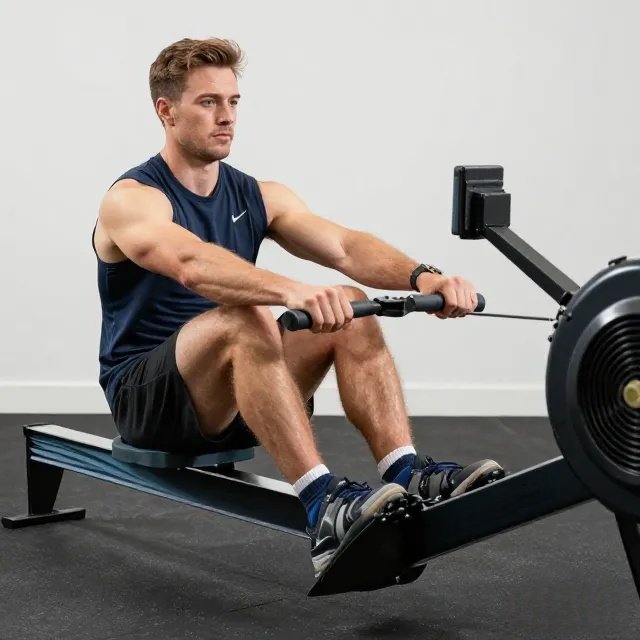
4. Rowing Machine: The Unsung Hero
Rowing often goes unnoticed in the gym, and that’s a huge oversight. When you row, your legs do 60% of the work. You push off the platform, and this movement engages your hips and glutes while gently working your knees.
Rowing is the perfect combination of cardio and strength training. It strengthens your back, abs, and legs, while putting minimal stress on your knees, as they move in a smooth arc without your body weight bearing down on them.
- Important: Master the technique! The main movement starts with the legs, then the torso leans back, and only then do the arms pull the handle toward the waist. The reverse movement: arms, torso, legs.
5. Nordic Walking: Walking with a Purpose
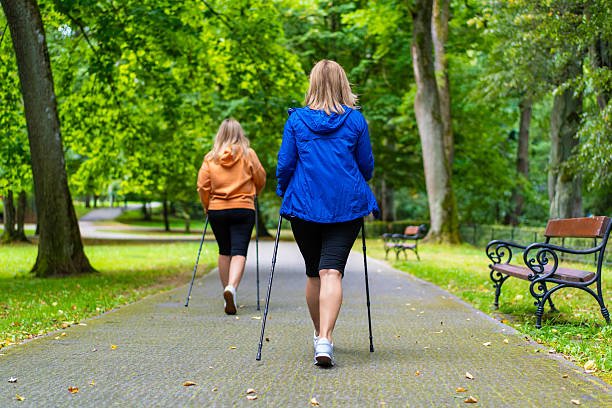
Surprisingly, regular walking on asphalt may not be the best option for those with knee issues. It creates an impact load, albeit less than running. Dr. Burns even notes that walking alone doesn’t always strengthen the muscles around the knee as effectively as needed.
But there’s an upgrade—Nordic walking with poles. When you lean on the poles, you reduce the load on your knee joints by about 30%. It’s like walking on all fours, distributing your body weight. It allows you to walk longer, burn more energy, and protect your joints at the same time.
Choose dirt paths in the park rather than city sidewalks.
20-Minute Circuit Workout: Let’s Do This Together
Theory is great, but let’s move on to practice. Here’s an example of a workout you can do at home without special equipment (all you need is a chair). This routine is designed to keep your heart rate in the fat-burning zone, but completely excludes jumping and high-impact movements.
Format: Circuit training. Perform the exercises one after another without rest. Rest for 60–90 seconds only after completing the entire circuit. Do a total of 3–4 circuits.
Warm-up (5 minutes):
- Walking in place with high knee lifts (but gently—don’t slap your heels).
- Rolling from heel to toe.
- Ankle rotations and standing knee bends.
Main Circuit:
1. The Chair Stand
Fitness bloggers call this exercise one of the most underrated. 2. Side Leg Lifts 3. Mountain Climbers — Slow
- Technique: Sit on the edge of a stable chair with your back straight. As you exhale, stand up energetically; you can help yourself by swinging your arms upward. Slowly and in a controlled manner, sit back down. Under no circumstances should you “plop” down on the chair with your full weight—this creates an impact.
- Why it works: This is a fully functional movement that burns a lot of calories (up to 60 kcal in 5 minutes!) and engages your glutes and thighs.
- Duration: 40 seconds of work.
- Technique: Stand straight, holding onto a wall or the back of a chair for balance. Shift your weight onto your right leg. Bring your left leg out to the side and lift it to a comfortable height (up to hip level, if your flexibility allows). Lower it back down. This movement engages the gluteus medius, which is very important for knee stability.
- Time: 20 seconds per leg, then switch immediately.
Usually, “Rock Climbers” are done with jumps, which are hard on the knees. We’ll do it differently. 4. Supported Calf Raises 5. Curtsy Lunge After one round—rest for 90 seconds. Then do 2–3 more rounds.
- Technique: Get into a push-up position (plank on straight arms). Make sure your lower back doesn’t arch. Slowly pull your right knee toward your chest, then place your foot back down. Now the left. Do this at the pace of a brisk but controlled walk while in the plank position .
- Time: 40 seconds.
- Technique: Stand upright, holding onto a support. Slowly rise onto your toes as high as possible, hold for a second at the top, and lower yourself just as slowly.
- Why it’s important: Strong ankles and calves help cushion your step, reducing the load on your knees.
- Time: 30 seconds.
- Technique: Stand up straight. Step back with your left foot, bringing it behind your right (like a curtsy). Bend your knees into a lunge until your right thigh is parallel to the floor (or comfortable). Return to the starting position. Repeat on the other leg.
- Why: This exercise strengthens the ligaments in an unconventional plane, making the joint more stable.
- Time: 40 seconds (alternating legs).
What to AVOID Like the Plague: The Red List of Exercises
While you’re learning how to do cardio with bad knees without pain, it’s important to know what’s strictly off-limits. Here are the activities that can undo all your efforts and send you straight to the doctor.
- Running (especially on asphalt). Every step is an impact that’s 3–5 times your body weight. For a bad knee, that’s a disaster.
- Jumping rope and plyometrics (burpees, jumping jacks). Same story. The sudden impact instantly causes pain.
- Walking lunges. Especially with weights. When you take a wide step and your knee extends far beyond your toes, the ligaments experience tremendous stress.
- Deep Squats. You can and should squat, but only to a 90-degree angle. A deep squat, where the pelvis drops below the knees (“butt to the floor”), overloads the menisci.
Frequently Asked Questions (FAQ)
Q: Can I do cardio every day?
A: Listen to your body. If the pain subsides and you feel a surge of energy, a light 30-minute bike ride or swim is fine every day. But strength training (like in our circuit) is best done 2–3 times a week, giving your muscles time to recover.
Q: Do I need a special diet or supplements?
A: Weight management is important for your joints. Every extra pound puts additional strain on your knees. A balanced diet with enough protein (for your muscles) and omega-3 fatty acids (to reduce inflammation) will be a great help. But supplements (chondroprotectors) should only be taken after consulting a doctor.
Q: What if I feel pain while doing the exercises from your list?
A: Stop immediately. You may be doing the exercise incorrectly. Go back to the “Two-Hour Rule.” If the pain is sharp, that’s a reason to see an orthopedist. You may have specific limitations that you are unaware of.
Conclusion: Movement is life, even with pain
Friends, knee pain isn’t a red traffic light requiring a complete stop. It’s a yellow light—a sign to “be more careful.” Use the proven methods we discussed today: swim, cycle, walk with poles, and do smart home workouts.
Don’t let the fear of pain rob you of the joy of movement and heart health. Start small. Today, just go to the pool or hop on an exercise bike for 15 minutes. Listen to your knees. Chances are, they’ll thank you.
This article is for informational purposes only. Before starting any new exercise program, especially if you have chronic health conditions, consult your doctor or a physical therapist
Want this article to read in pdf later?
Enter your Email Address to get this article in pdf format